
STP Tank Waterproofing in Ahmedabad
- Home
- /
- STP Tank Waterproofing in Ahmedabad
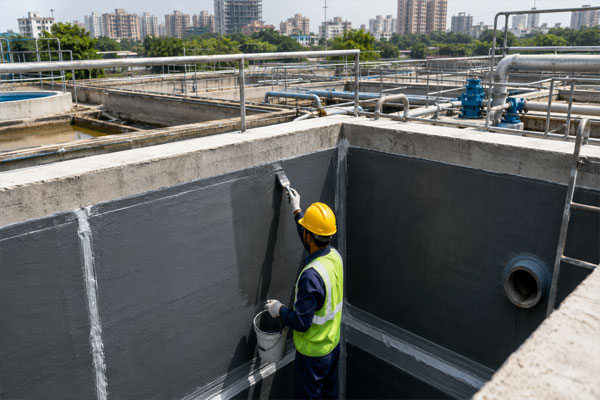
Professional STP Tank Leakage Repair Services in Ahmedabad
An STP tank stores and treats sewage water from homes, housing societies, factories, hotels, hospitals and commercial buildings. The tank remains exposed to moisture, sludge, wastewater and cleaning chemicals every day.
A small crack in an STP tank may look harmless at first. Over time, dirty water can leak through the crack and reach the surrounding soil, basement or building foundation. Water may also reach the steel bars inside the concrete and cause rust.
A proper STP tank waterproofing system seals cracks, joints, pores and weak concrete areas. It also creates a protective layer between the wastewater and the concrete surface.
Dhyey Waterproofers provides STP tank waterproofing in Ahmedabad using surface cleaning, crack repair, primer and specialised coating systems selected for sewage-treatment tanks.
Can Waterproofing Stop STP Tank Leakage?
Yes, professional waterproofing can help control leakage when water is passing through:
- Concrete cracks
- Construction joints
- Floor and wall joints
- Pipe entry points
- Honeycombed concrete
- Weak plaster or repair mortar
- Small holes and surface pores
- Damaged waterproof coatings
Waterproofing should not be limited to covering the visible wet area. The contractor must first identify why the tank is leaking.
A complete solution may include crack filling, injection grouting, joint sealing, concrete repair and a chemical-resistant coating. The exact system depends on the condition of the tank and the type of wastewater it handles.
What Is STP Tank Waterproofing?
STP tank waterproofing is a process used to protect sewage-treatment tanks from leakage, seepage and surface damage.
The treatment is normally applied to the internal concrete walls and floor. External waterproofing may also be required when groundwater is entering the tank from outside.
A complete waterproofing system may include:
- Tank cleaning and sludge removal
- Concrete surface inspection
- Crack and honeycomb repair
- Joint and pipe-opening treatment
- Primer application
- Chemical-resistant waterproof coating
- Curing and final checking
A normal cement layer may not be enough for an STP tank. The selected coating must match the concrete condition, wastewater exposure and operating requirements. Dhyey Waterproofers’ service process includes cleaning, crack repair, primer, multiple coating layers and a final inspection.
Cracks in Concrete
Concrete may develop cracks because of:
- Drying and shrinkage
- Temperature changes
- Settlement
- Vibration
- Poor construction
- Heavy load
- Structural movement
Wastewater can enter these cracks and slowly make them wider.
Weak Construction Joints
Construction joints are formed where one concrete pour meets another. If these joints are not treated correctly, they may become major leakage points.
STP Waterproofing Process at a Glance
Stage | Work Done | Main Purpose |
Isolation | Stop tank operation | Create a safe work area |
Dewatering | Remove water and sludge | Expose the full surface |
Safety check | Test air and control entry | Protect workers |
Cleaning | Remove dirt and old coating | Prepare strong concrete |
Inspection | Find cracks and weak areas | Plan the correct repair |
Crack repair | Seal cracks and leakage paths | Stop local seepage |
Concrete repair | Rebuild weak sections | Restore the surface |
Joint sealing | Treat joints and pipes | Protect common weak points |
Priming | Apply a bonding layer | Improve coating adhesion |
Coating | Apply protective layers | Waterproof the tank |
Curing | Allow the system to harden | Build full performance |
Testing | Check for defects and leakage | Confirm treatment quality |
Why Normal Cement Coating Often Fails
Normal cement coating may provide temporary surface coverage, but it may not be suitable for every STP tank.
It can fail because:
- The surface was not cleaned properly.
- Active cracks were not repaired.
- Joints were ignored.
- Wastewater moved behind the coating.
- The concrete remained weak.
- The coating was not suitable for continuous immersion.
- The surface contained oil or sludge.
- The coating did not receive enough curing time.
- Groundwater pressure acted from the opposite side.
A lasting system needs proper repair and compatible materials—not only a fresh cement layer.
When Waterproof Coating Is Not Enough
Additional work may be required when:
- A structural crack is growing.
- The tank wall is badly damaged.
- Reinforcement steel is heavily rusted.
- Concrete is loose or soft.
- An expansion joint has failed.
- Pipes are moving.
- The tank has settlement.
- Water pressure is very high.
- The foundation has moved.
- Large sections of concrete are honeycombed.
- The wastewater is highly aggressive.
- The tank design has a major fault.
A structural engineer may be required for wide cracks, movement, settlement or loss of concrete strength.
Waterproof coating should not be used to hide a structural problem.
Why Choose Dhyey Waterproofers?
Ahmedabad-Based Support
The company is based in Isanpur and serves waterproofing requirements in Ahmedabad.
Detailed Tank Inspection
Cracks, joints, pipes and damaged concrete should be inspected before selecting a treatment.
Complete Surface Preparation
The service process includes tank cleaning and removal of sludge, oil and loose material.
Crack and Concrete Repair
Weak areas are repaired before the waterproof coating is applied.
Compatible Coating System
The coating is selected according to the tank’s condition and operating environment.
Multiple Waterproofing Services
Related services include injection grouting, tank waterproofing, concrete repair and industrial waterproofing.
Frequently Asked Questions
What is STP tank waterproofing?
STP tank waterproofing is the process of repairing cracks, sealing joints and applying a protective coating to stop sewage leakage and protect concrete.
Why do STP tanks need chemical-resistant coatings?
STP tanks remain exposed to wastewater, sludge, moisture and cleaning chemicals. A compatible protective coating helps separate these materials from the concrete surface.
Can waterproofing stop active STP tank leakage?
Yes, but active cracks may first need injection grouting or another leakage-control method before the full coating is applied.
Which coating is best for an STP tank?
The best coating depends on the wastewater, pH, concrete condition, tank design and immersion requirement. Epoxy, resin-based and cementitious systems may be considered after inspection.
Can normal cement stop STP tank leakage?
Normal cement may close a small surface gap, but it may not seal deep cracks, joints or chemical exposure areas.
How are cracks repaired inside an STP tank?
Cracks may be opened and filled, injected with grout or sealed with flexible material depending on their depth, movement and water flow.
Can STP waterproofing protect steel reinforcement?
Waterproofing helps reduce water reaching the reinforcement, but already rusted steel must be cleaned and repaired before coating.
Conclusion
STP tank leakage should not be repaired with surface cement alone. Cracks, weak joints, pipe openings and damaged concrete must be treated before the main waterproof coating is applied.
A complete STP waterproofing system helps stop sewage leakage, reduce concrete damage and protect nearby building areas. Good results depend on safe tank entry, deep cleaning, correct repairs, compatible materials and proper curing.