
PU Grouting for Basement Leakage
- Home
- /
- PU Grouting for Basement Leakage
Professional PU Grouting Services for Basement Leakage in Ahmedabad
Basements are built below ground level. Because of this, they remain in contact with wet soil and groundwater. Even a small crack in a basement wall or floor can allow water to enter.
At first, you may notice a damp patch or a white powder-like mark. Later, the same area may develop peeling paint, fungus, bad smell or active water dripping. Ignoring the problem can damage plaster, flooring, stored goods and electrical systems.
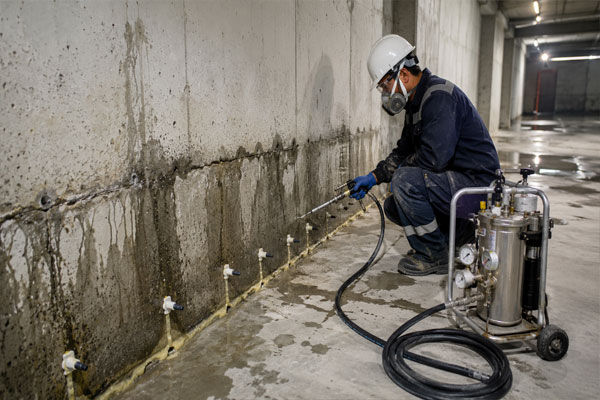
PU injection grouting is a useful method for stopping water that is entering through cracks, joints and empty spaces inside concrete. The liquid resin is injected into the affected area through small holes. It reacts with moisture, expands and blocks the hidden water path. Different PU injection materials may be used depending on the amount of water, crack condition and required type of seal.
Can PU Grouting Stop Basement Leakage?
Yes, PU injection grouting can stop basement leakage when water is entering through:
- Concrete cracks
- Construction joints
- Floor and wall joints
- Pipe openings
- Honeycombed concrete
- Small cavities and gaps
- Lift pits and underground walls
The resin is injected inside the crack instead of being applied only on the surface. This allows it to reach hidden water paths that ordinary cement filling may miss.
However, PU grouting is mainly used for waterproof sealing. Large structural cracks, weak concrete, damaged reinforcement or building movement may need additional repair.
What Is PU Injection Grouting?
PU stands for polyurethane.
PU injection grouting is a process in which liquid polyurethane material is pumped into cracks, joints or empty spaces under controlled pressure.
Some PU resins react when they meet water. They expand and form foam inside the crack. Other PU resins form a flexible, non-foaming seal. In situations with heavy water flow, a foaming resin may first be used to control the active leak, followed by a suitable non-foaming resin for a more durable waterproof seal.
The process in simple words:
- The leaking area is inspected.
- Small holes are drilled near the crack.
- Injection packers are fitted into the holes.
- PU resin is pumped into the crack.
- The resin spreads through the internal gaps.
- It reacts with moisture and blocks the water path.
- Packers are removed and holes are repaired.
- The area is checked again for leakage.
Why Do Basements Develop Water Leakage?
Cracks in Concrete Walls
Concrete can develop cracks because of drying, temperature changes, settlement or movement. Water from the surrounding soil can enter through these cracks.
Weak Construction Joints
A construction joint forms where one concrete section meets another. If the joint is not properly sealed, it may become a water-entry point.
Floor and Wall Joint Leakage
The connection between the basement floor and wall is often exposed to groundwater pressure. A small gap in this area can cause continuous seepage.
Pipe Openings
Water can enter through spaces around drainage pipes, electrical sleeves and utility lines passing through basement walls.
Basement Areas That Can Be Treated
Basement Walls
Cracks and joints in underground walls are common leakage points. PU injection can seal a local water path without opening the entire external wall.
Basement Floors
Water may rise through floor cracks, joints or weak concrete areas. The floor condition and groundwater pressure must be checked before treatment.
Wall-to-Floor Joints
This joint is a common weak area because two parts of the structure meet here. Injection may be combined with joint repair or another waterproofing system.
Lift Pits
Lift pits are located at a low level and may collect groundwater. PU grouting can be used for leaking cracks and joints after checking the site condition.
Problems PU Grouting Can Help Solve
Basement Problem | Possible Cause | Possible Treatment |
Water dripping from a crack | Active water path | PU injection grouting |
Damp wall after rain | External moisture entry | Crack injection plus surface protection |
Leakage at floor-wall joint | Weak joint or groundwater pressure | Joint injection and waterproof repair |
Water around a pipe | Gap around penetration | Local injection and sealing |
Wet lift pit | Crack, joint or groundwater | PU injection after inspection |
White marks on wall | Moisture movement | Stop water source and repair finish |
Repeated leakage after cement repair | Internal crack not filled | Pressure injection may be required |
Multiple wet areas | Failed waterproofing or drainage | Combined waterproofing system |
PU Grouting vs Other Leakage Treatments
Method | Best Used For | Main Limitation |
Cement filling | Small dry surface gaps | May not reach deep water paths |
PU injection | Active water in cracks and joints | Not a replacement for structural repair |
Epoxy injection | Structural bonding of suitable dry or slightly damp cracks | Usually not selected for flowing water |
Acrylic injection | Fine cracks, joints and wider-area injection systems | Needs specialised product selection |
Waterproof coating | Broad surface protection | Does not always fill deep cracks |
Membrane waterproofing | Large accessible areas | Outer basement wall may not be accessible |
Drainage improvement | Reducing water around the building | Does not seal an existing crack |
Epoxy resins are generally rigid and used for structural crack repair, while flexible PU resins are commonly used for non-structural waterproof sealing of cracks, joints and voids.
When PU Injection Grouting Is Not Enough
PU grouting is useful, but it cannot solve every basement problem by itself.
Additional work may be required when:
- The concrete is badly broken
- Steel reinforcement is exposed or rusted
- A crack is growing
- The building is settling
- There is heavy structural movement
- An expansion joint has failed
- Drainage around the building is poor
- Water enters from many unknown points
- The whole external waterproofing system has failed
- A plumbing line is leaking
- The floor is lifting or sinking
- Concrete contains large weak areas
A structural engineer should inspect wide, growing or load-related cracks. PU waterproofing resin should not be presented as a structural strengthening material unless the selected system is specifically designed and approved for that purpose.
How to Choose the Right PU Grouting Contractor
Before starting work, ask the contractor these questions:
- Have you found the actual water source?
- Is the crack structural or non-structural?
- Which type of PU resin will be used?
- Is it a foaming or non-foaming product?
- Will a second injection material be needed?
- How will the drilling points be planned?
- What injection pressure will be used?
- How will the repaired area be tested?
- Is another waterproofing treatment required?
- What site preparation should the owner complete?
- Will damaged plaster be repaired?
- What maintenance will be required?
The success of injection work depends on selecting the correct material, equipment and application method. Experienced application is important.
Why Choose Dhyey Waterproofers?
Dhyey Waterproofers is based in Isanpur, Ahmedabad, and provides waterproofing, grouting, flooring and repair services for residential, commercial and industrial properties. Its listed PU grouting process includes site inspection, surface cleaning, crack evaluation, angled drilling, packer installation, pressure injection and final inspection.
Service Advantages
- Local Ahmedabad service support
- Inspection before treatment
- Work for residential and industrial properties
- PU injection for cracks and joints
- Basement and underground-area experience
- Support for related waterproofing repairs
- Treatment planning based on the leakage condition
Frequently Asked Questions
What is PU injection grouting?
PU injection grouting is a waterproofing method in which polyurethane resin is pumped into concrete cracks, joints or gaps to block water leakage.
Can PU grouting stop active basement leakage?
Yes. Water-reactive PU materials are designed to react with moisture and control active water entering through cracks or joints.
Can PU grouting be done from inside the basement?
In many cases, yes. The resin can be injected from the accessible inner side when the external basement wall cannot be reached.
Does the whole wall need to be broken?
Normally, small injection holes are drilled. Large-scale breaking may be needed only when concrete or plaster is badly damaged.
Can PU injection seal floor and wall joints?
Yes, suitable PU injection systems can seal leaking joints after the joint and water pressure are properly inspected.
Is PU grouting suitable for lift-pit leakage?
It can be used for cracks and joints in lift pits. The full pit, drainage and groundwater condition should first be checked.
Conclusion
Basement leakage should be repaired at its source. Painting over a damp wall or filling only the visible crack may provide temporary relief, but the water can return through another hidden route.
PU injection grouting works by sending waterproof resin inside concrete cracks, joints and voids. The material fills hidden spaces and helps stop active water flow. It is useful for basement walls, floor joints, lift pits, pipe openings and underground concrete areas.
A lasting repair depends on correct inspection, resin selection, drilling, injection pressure and final testing. Large structural cracks, damaged concrete and poor drainage may also need additional work.