
PU Injection Grouting Stops Active Water Leakage
- Home
- /
- PU Injection Grouting Stops Active Water Leakage
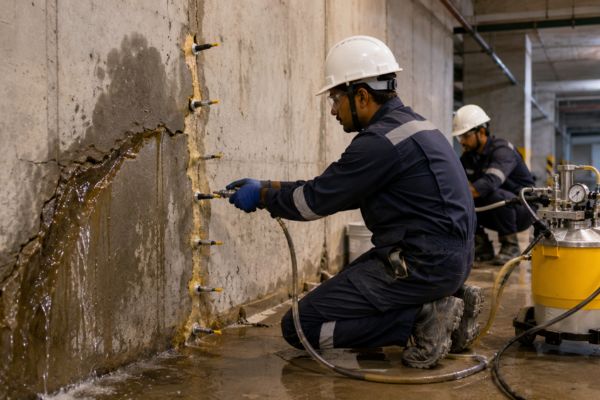
How PU Injection Grouting Stops Active Water Leakage in Ahmedabad Buildings
Water dripping through a basement wall, damp patches appearing on an RCC slab, or water coming through a concrete joint can be difficult to repair with surface treatment alone. In many cases, the visible wet area is only the final point where water appears. The real water path may be hidden deep inside a crack, joint or void.
This is where PU Injection Grouting in Ahmedabad can be useful. Instead of treating only the outside surface, polyurethane material is injected into cracks and voids through specially placed injection points. Water-reactive PU materials can foam when they meet moisture and spread through hidden spaces, helping block the path through which water is entering.
Dhyey Waterproofers provides PU Injection Grouting Service in Ahmedabad for concrete crack and leakage problems in areas such as basements, RCC slabs, walls, water-retaining structures and other difficult leakage locations. Its published process includes inspection, crack evaluation, installation of injection packers, PU injection, curing and final checking.
This guide explains how PU grouting works, where it can be used, when it may not be the right solution and what property owners should check before starting the repair.
Quick Answer: How Does PU Injection Grouting Stop Water Leakage?
PU injection grouting stops water leakage by injecting polyurethane material into the internal path of a crack, joint or void.
For active water leaks, a water-reactive PU foam can:
- Enter the crack under pressure
- React when it contacts water
- Expand inside the crack or void
- Fill irregular spaces
- Reduce or stop the passage of water
Certain PU injection foams are specifically designed to stop flowing water in cracks, joints and cavities. However, some foaming products are intended mainly for temporary water stopping and may need a second injection with a suitable resin for permanent watertight sealing.
That is why the contractor should select the injection material according to the actual leak rather than using one PU product for every situation.
What Is PU Injection Grouting?
PU Injection Grouting is a repair method in which polyurethane-based material is injected into cracks, joints or empty spaces inside concrete or masonry.
Small holes are generally drilled near the leakage path. Injection packers or nipples are installed, and the PU material is pumped into the structure under controlled pressure.
Dhyey Waterproofers’ current service process follows this general method: site inspection, surface cleaning, crack evaluation, packer installation, PU injection, curing and final inspection.
The main advantage is that the material can reach areas inside the structure that are difficult to treat only from the surface.
Why Surface Repair May Not Stop an Active Leak
Imagine a basement wall with water appearing through a small crack.
You apply cement mortar over the visible wet area.
A few days later, water starts appearing beside the repair.
Why?
Because the water path behind the concrete was not blocked.
Water can move through:
- Cracks
- Construction joints
- Honeycombed concrete
- Small cavities
- Gaps around penetrations
- Weak concrete areas
Covering only the exit point may force water to find another path.
PU injection works differently because the repair material is introduced inside the leakage path.
Active Water Leakage vs Dampness: Know the Difference
Not every wet wall needs PU injection.
Active Water Leakage
- Water dripping
- Running water
- Water coming through a crack
- Continuous wetness from one joint
- Leakage that increases during rain
General Dampness
- Broad damp patches
- Peeling paint
- White deposits
- Moist walls
- No clear leakage point
General dampness may come from several causes, including external waterproofing failure, plumbing, rising moisture or condensation.
In these cases, injecting PU without identifying the real source may not solve the problem.
PU Grouting for Basement Water Leakage
Basements are one of the most common areas where injection waterproofing is considered.
Water may enter through:
- RCC wall cracks
- Wall-floor joints
- Construction joints
- Honeycombed concrete
- Service penetrations
- Underground pressure points
Because the water source is often outside the basement wall, opening and waterproofing the external side may not always be easy.
PU injection can sometimes be carried out from the accessible internal side to target the water path.
Water-reactive PU injection products are widely used for stopping water intrusion through cracks, joints and cavities in concrete structures.
Problem: Basement Wall Leaks Every Monsoon
A basement may remain mostly dry for months and start leaking when groundwater or rainwater pressure increases during monsoon.
Typical signs include:
- Wet concrete joints
- Water lines on walls
- Dripping from cracks
- Damp floor-wall corners
- Repeated paint failure
Better Approach
Do not paint over the damp wall first.
Check:
Where does water enter? → Is there an active crack? → Is the joint leaking? → Is external waterproofing damaged? → Is injection suitable?
A targeted repair is usually more useful than treating every wet area with the same product.
PU Injection for RCC Wall Cracks
PU Injection for RCC Wall Cracks
Concrete can develop cracks for many reasons.
Some cracks remain dry.
Others become water paths.
When an RCC wall crack carries water, injection material may be used to fill the internal crack path.
Flexible PU injection systems are available for sealing wet cracks and joints while allowing limited movement after curing.
However, waterproofing repair and structural crack repair are not automatically the same thing.
If the crack may affect structural safety, it should be assessed by an appropriate engineer before assuming PU waterproofing alone is enough.
PU Injection Grouting for RCC Slab Leakage
Water can sometimes pass through cracks or joints in an RCC slab and appear on the ceiling below.
Common problem areas include:
- Roof slabs
- Podium slabs
- Basement slabs
- Construction joints
- Service openings
The first job is to identify whether the problem is:
- A localized crack
- Failed top-side waterproofing
- Plumbing leakage
- A construction joint
- A wider slab problem
PU injection can be useful for selected cracks and joints, but it should not automatically replace complete terrace waterproofing when the whole upper surface has failed.
Problem: “Water Is Coming Through My Ceiling. Should I Use PU Grouting?”
Not immediately.
First identify the source.
Possible causes include:
- RCC crack
- Bathroom leakage
- Terrace waterproofing failure
- Pipe leakage
- Water tank
- Expansion/construction joint
PU injection is most useful when the leakage path can be identified and reached through injection.
If the complete terrace waterproofing system has failed, broader waterproofing work may also be required.
PU Grouting for Construction Joints
Concrete is often poured in different stages.
The meeting point between two concrete pours creates a construction joint.
If the joint develops gaps or its waterproofing fails, it can become a water path.
Injection grouting materials are commonly used to stop water through cracks, joints and cavities in concrete.
The contractor may drill injection points along the leaking joint and introduce the PU material into the internal void.
PU Grouting for Honeycombed Concrete and Voids
Concrete is not always completely dense.
Poorly compacted areas can develop:
- Honeycombing
- Empty pockets
- Connected voids
- Weak pathways
Water can use these internal spaces to travel through the structure.
Injection may help fill selected voids and block water paths, depending on the concrete condition and material used.
A proper inspection is important because badly damaged concrete may require additional repair work beyond injection.
PU Injection Around Pipe Penetrations
Basements, tanks and service areas often contain pipes passing through RCC walls or slabs.
Leakage may develop around:
- Drain pipes
- Water pipes
- Utility sleeves
- Electrical conduits
- Service openings
If a small gap remains around the penetration, water may enter under pressure.
A contractor may use injection around the joint to fill hidden spaces where appropriate.
The surrounding concrete and pipe joint should also be inspected before choosing the repair method.
How Does PU React with Water?
Certain polyurethane injection products are water-reactive.
When the liquid material enters a wet crack, it reacts with water and creates foam.
For example, Sika describes water-reactive PU injection products that form a dense flexible foam when they contact water. Depending on the specific product, free expansion can be many times the original liquid volume.
This expansion helps the material move into irregular voids and interrupt the water path.
Important
The amount of expansion varies by product.
Do not assume that every PU resin or every PU foam behaves in exactly the same way.
PU Injection Foam vs PU Injection Resin
| PU Injection Foam | PU Injection Resin |
|---|---|
| Commonly reacts with water | Product behavior varies |
| Expands rapidly | Often lower expansion |
| Useful for active water stopping | Useful for sealing cracks/joints |
| Can fill irregular voids | Can create flexible watertight seal |
Sika’s technical guidance explains that water-reactive PU foam is commonly used to quickly stop flowing water, while suitable PU resins can be used for longer-term flexible crack sealing. Some systems require the foaming water-stop stage to be followed by resin injection for permanent sealing.
This distinction is one reason experienced product selection matters.
Step-by-Step PU Injection Grouting Process
Dhyey Waterproofers describes a six-stage injection process on its Ahmedabad service page.
Step 1: Site Inspection
The affected area is inspected to find:
- Active leak points
- Visible cracks
- Construction joints
- Concrete condition
- Possible water paths
The aim is to understand where the water is entering before drilling begins.
Step 2: Surface Cleaning
Loose material, dirt and other contaminants are removed around the repair area.
Injection-product manufacturers also require crack and joint areas to be free from material that can interfere with the repair process.
Step 3: Crack Evaluation and Drilling
Small holes are drilled at planned positions around the crack.
The drilling angle and spacing should allow the injection path to reach the crack or void.
Injection packers are then fitted into the holes.
Step 4: PU Material Is Injected
A suitable pump pushes the polyurethane material through the installed packer.
Dhyey’s stated process continues injection until the material reaches the neighbouring injection area, indicating that the crack path is being filled.
The exact injection pressure and material should depend on the structure and chosen system.
Step 5: Reaction and Curing
For water-reactive systems, the PU reacts with moisture and forms foam within the wet crack or void.
Other resin systems cure differently.
The contractor should follow the injection-product manufacturer’s instructions.
Step 6: Finishing and Inspection
After the injection has cured:
- Packers can be removed
- Injection holes are repaired
- Surface finishing is completed
- The leakage point is checked again
Why Injection Pressure Matters
The aim of injection is to get material into the internal water path.
Too little pressure may not move the material far enough.
Incorrect or excessive pressure can also be unsuitable for the structure.
This is why professional injection uses controlled equipment and trained operators rather than simply filling a crack from the surface.
Where Is PU Injection Grouting Commonly Used?
PU grouting can be considered for selected leakage problems in:
- Basements
- RCC walls
- RCC slabs
- Construction joints
- Underground structures
- Water-retaining structures
- Lift pits
- Concrete tanks
- Utility pits
- Tunnels and civil structures
- Pipe penetrations
Water-reactive PU systems are used in civil engineering for water intrusion through concrete and masonry cracks, joints and cavities.
Dhyey Waterproofers specifically markets its service for concrete cracks, basement walls, water tanks and concrete slabs in Ahmedabad.
PU Injection Grouting for Lift Pit Leakage
Lift pits are below ground level and may face water seepage through:
- Wall-floor joints
- RCC cracks
- Service openings
- Construction joints
Because lift pits contain important equipment, recurring water should not be ignored.
A contractor should first identify the actual entry points.
Where leakage is concentrated through cracks or joints, PU injection may form part of the repair solution.
PU Injection Grouting for Water Tanks
Leakage from an RCC tank may occur through:
- Cracks
- Construction joints
- Pipe penetrations
- Weak concrete areas
Before injecting any water-retaining or drinking-water structure, the selected repair material must be confirmed as suitable for that specific use.
Do not assume every PU injection chemical is appropriate for potable-water contact.
When Is PU Injection Grouting a Good Choice?
PU injection may be considered when:
- Water is actively flowing through a concrete crack
- The leakage path is inside the structure
- External access is difficult
- A construction joint is leaking
- Water enters through an internal void
- A basement crack leaks during monsoon
- Local surface patches repeatedly fail
The final recommendation should depend on site inspection.
When May PU Grouting NOT Be Enough?
PU grouting is not the answer to every waterproofing problem.
Additional work may be required when:
The Entire Terrace Waterproofing Has Failed
A few injections will not restore a complete damaged waterproofing layer.
Drainage Is Poor
Water stagnation should also be corrected.
Concrete Is Heavily Damaged
Weak concrete may require repair or strengthening.
Leakage Comes from Plumbing
Fix the pipe instead.
A Crack May Be Structural
Get appropriate structural assessment.
Water Is Entering Through Many Unrelated Areas
A broader waterproofing system may be more suitable.
PU Injection Grouting vs Surface Waterproofing
| PU Injection Grouting | Surface Waterproofing |
|---|---|
| Works inside cracks/voids | Works mainly from the surface |
| Useful for localized active leaks | Useful for larger exposed areas |
| Requires injection points | Requires surface preparation |
| Can reach hidden water paths | Protects the treated surface |
| Good for joints and cracks | Good for terraces/walls depending on the system |
The two methods are not always competitors.
A building may need both.
PU Grouting vs Epoxy Injection
People often ask whether PU or epoxy should be used for a crack.
The answer depends on the purpose.
PU Injection
Often selected where:
- Water is present
- Active leakage needs to be stopped
- Some flexibility is useful
Epoxy Injection
Often considered for appropriate structural crack-bonding applications where restoring concrete continuity is the main objective.
Sika’s technical guidance distinguishes flexible PU waterproofing injection from epoxy resins used for structural crack sealing.
Do not select material only because one product is “stronger.”
Select it according to water condition + crack movement + repair objective + structural condition.
Why Cement Filling May Fail on Active Water Cracks
Cement-based repair materials can be useful in many concrete repairs, but an actively flowing crack creates a different problem.
Water pressure may:
- Wash material away
- Prevent proper bonding
- Find another nearby gap
- Continue through the depth of the crack
Water-reactive injection material is designed to move into internal leakage paths rather than treating only the visible surface.
Why Leakage Can Appear Away from the Actual Crack
Water does not always travel straight through concrete.
It can move through:
- Connected voids
- Joints
- Honeycombing
- Internal cracks
This means the wet patch you can see may be some distance from the original water entry point.
That is why professional Water Leakage Grouting Service in Ahmedabad should begin with diagnosis rather than drilling directly into every damp spot.
Signs Your Building May Need Injection Grouting
Arrange an inspection if you notice:
- Water flowing from a concrete crack
- Basement leakage during monsoon
- Repeated RCC joint seepage
- Water entering around pipe penetrations
- Wet construction joints
- Leakage from underground RCC walls
- Lift pit water seepage
- Surface repairs failing repeatedly
These signs do not prove PU injection is required, but they are good reasons to inspect the structure.
What Should You Ask a PU Grouting Contractor?
Before approving work, ask:
- Where is the actual water entry path?
- Why are you recommending PU injection?
- Which PU material will be used?
- Is it a water-stop foam or permanent sealing resin?
- Does the repair require one injection stage or more?
- Where will injection holes be drilled?
- How will the injection pressure be controlled?
- What happens to the packer holes afterward?
- Does external waterproofing also need repair?
- How will the completed work be checked?
A clear answer is more useful than simply hearing:
“We will inject chemical and the problem will be solved.”
PU Injection Grouting Checklist
Before starting the work, confirm:
- Source of leakage inspected
- Crack or joint identified
- Concrete condition checked
- Active water condition understood
- Correct PU material selected
- Injection points planned
- Packers installed correctly
- Injection equipment available
- Required finishing work discussed
- Need for additional waterproofing checked
- Final inspection included
PU Injection Grouting Before Ahmedabad Monsoon
Ahmedabad buildings may show previously hidden leakage problems when heavy rainfall increases water exposure around terraces, external walls and below-ground structures.
Basement owners, societies, commercial buildings and industrial properties should inspect known weak areas before the rainy season.
Pay attention to:
- Old RCC cracks
- Basement construction joints
- Lift pits
- Pipe entries
- Previous leakage areas
- Repaired joints
- Underground walls
If a crack already shows seepage before heavy rainfall, early inspection can make repair planning easier.
PU Grouting for Residential Buildings in Ahmedabad
Residential properties may require injection treatment for localized leakage in:
- Basement walls
- RCC slabs
- Underground tanks
- Parking areas
- Construction joints
- Lift pits
The contractor should first confirm whether the problem is truly coming through a concrete crack or joint.
PU Injection Grouting Before Ahmedabad Monsoon
Ahmedabad buildings may show previously hidden leakage problems when heavy rainfall increases water exposure around terraces, external walls and below-ground structures.
Basement owners, societies, commercial buildings and industrial properties should inspect known weak areas before the rainy season.
Pay attention to:
- Old RCC cracks
- Basement construction joints
- Lift pits
- Pipe entries
- Previous leakage areas
- Repaired joints
- Underground walls
If a crack already shows seepage before heavy rainfall, early inspection can make repair planning easier.
PU Grouting for Residential Buildings in Ahmedabad
Residential properties may require injection treatment for localized leakage in:
- Basement walls
- RCC slabs
- Underground tanks
- Parking areas
- Construction joints
- Lift pits
The contractor should first confirm whether the problem is truly coming through a concrete crack or joint.
PU Injection Grouting for Commercial Buildings
Commercial buildings cannot always afford repeated water leakage around:
- Parking basements
- Storage areas
- Lift pits
- Utility rooms
- RCC walls
Active leakage may affect interiors, equipment and normal building use.
A targeted injection repair can be considered when the leakage path is suitable for grouting.
PU Grouting for Industrial Properties in Ahmedabad
Factories and warehouses may develop water leakage through underground or RCC sections such as:
- Utility pits
- RCC tanks
- Basement areas
- Concrete walls
- Floor-wall joints
- Service penetrations
Industrial leakage should be inspected early when water is close to electrical equipment, machinery or stored materials.
PU Injection Grouting Service in Ahmedabad
Every leakage problem is different.
A basement crack, water tank joint and RCC slab should not automatically receive the same treatment.
For PU Injection Grouting in Ahmedabad, the contractor should assess:
Structure Type + Crack Condition + Water Flow + Moisture + Access + Previous Repairs
Dhyey Waterproofers provides PU Injection Grouting from its Ahmedabad base and lists concrete cracks, basement walls, water tanks and concrete slabs among the applications of its service.
Its published Ahmedabad address is in Isanpur.
Why Choose Dhyey Waterproofers for PU Injection Grouting?
Dhyey Waterproofers provides grouting, waterproofing and repairing services in Ahmedabad. Its PU injection service follows a defined process covering:
- Site inspection
- Surface preparation
- Crack evaluation
- Injection packer installation
- PU material injection
- Curing
- Finishing
- Final inspection
This approach is useful because successful leakage repair depends on identifying the water path before selecting the treatment.
For property owners searching for PU Injection Grouting Service in Ahmedabad, Dhyey Waterproofers can inspect the affected area and recommend whether injection grouting, another waterproofing treatment or a combination of repairs is appropriate.
Final Thoughts
Active water leakage inside concrete is difficult to solve when the real water path is hidden.
PU Injection Grouting can help by introducing polyurethane material directly into cracks, joints and internal voids rather than treating only the visible wet surface.
Water-reactive PU foams can expand inside wet cracks and rapidly block flowing water. Depending on the selected injection system, permanent waterproof sealing may require a suitable flexible PU resin or an additional injection stage.
The correct process should therefore be:
Find the Water Path → Identify the Crack or Joint → Select the Correct Injection Material → Inject Carefully → Allow Curing → Check the Repair → Treat Any Wider Waterproofing Problem
FAQs
What is PU Injection Grouting?
PU Injection Grouting is a method in which polyurethane material is injected into cracks, joints or voids to block water paths. Water-reactive PU products can expand into foam when they contact moisture.
Can PU injection stop active water leakage?
Yes, certain water-reactive PU injection foams are specifically designed to stop flowing water through cracks, joints and cavities.
Is PU injection grouting suitable for basement leakage?
It can be suitable when basement leakage is entering through identifiable concrete cracks, joints or voids. The source should be inspected before treatment.
Does PU grout expand inside a crack?
Water-reactive PU injection products can foam and expand after contacting water, helping them fill irregular spaces inside cracks and voids.
Is PU injection a permanent waterproofing solution?
It depends on the product and repair system. Some PU foams are mainly used for rapid or temporary water stopping, while appropriate flexible PU resins are designed for permanent sealing. Some repairs use both stages.
Can PU grouting repair RCC wall cracks?
PU injection can waterproof suitable wet cracks in RCC walls. If a crack raises structural concerns, structural assessment may also be required.
Is PU grouting suitable for roof leakage?
It may be useful for localized leakage through an identifiable RCC crack or joint. If the complete terrace waterproofing system has failed, broader waterproofing treatment may be needed.
What is the difference between PU grouting and surface waterproofing?
PU grouting works inside cracks, joints and voids. Surface waterproofing creates a protective treatment over a larger exposed surface. Some buildings need both methods.